
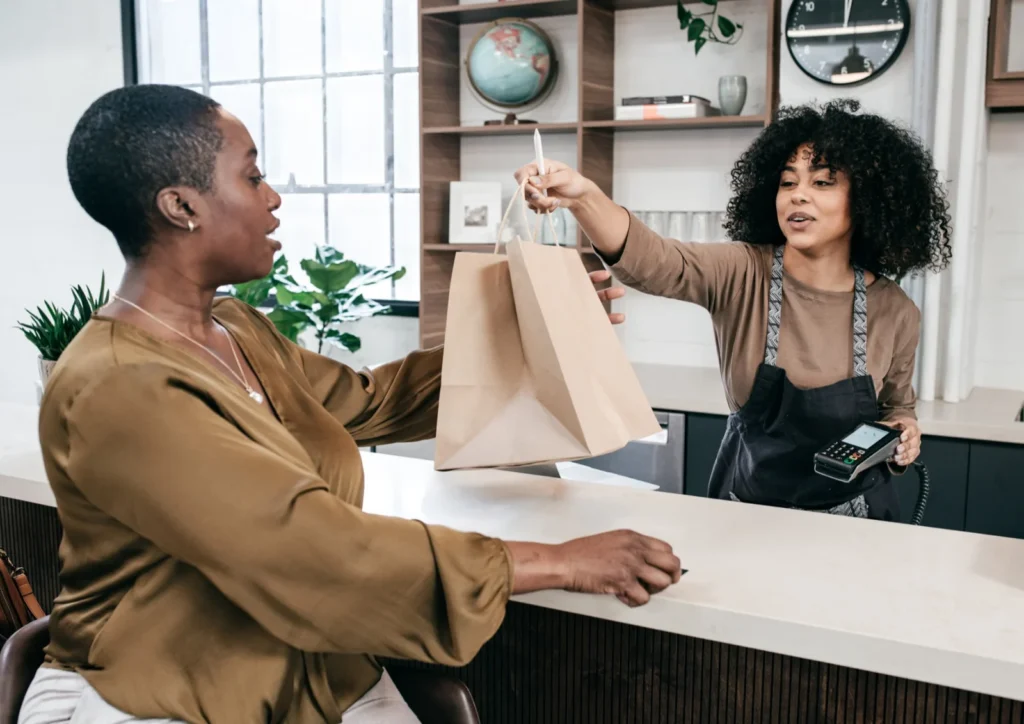

A store visit becomes a qualified contact when three conditions are met: the customer has given valid consent to be contacted again, you know through which channel and at which location they came in, and you have at least one piece of information that allows you to send them something relevant. Without these three elements, you simply have another address in a database, not a customer you can bring back.
Why most visits leave no usable trace
Point-of-sale software records a transaction, not a relationship
By default, a customer who pays at the checkout leaves behind an amount, a date, and a payment method. They provide neither their contact details nor their consent to receive your offers, nor any indication of what brought them in. Once they leave, the connection ends, and their next visit, if there is one, will be just as anonymous.
A collected address is not necessarily usable
Many businesses collect email addresses without being able to use them. For example, an address requested to send a digital receipt does not constitute consent to receive marketing offers. The CNIL makes this clear: accepting general terms and conditions of sale does not constitute consent to marketing communications. A database built this way grows quickly, but it creates legal risk and generates few responses.
The best time to ask is during the visit
A customer who is in the store is available, engaged with your offering, and often pleased with what they have just found. Once they return home, a similar request becomes less of a priority. The request is most likely to succeed during the visit or immediately afterward.
The three criteria for a qualified contact
Valid and verifiable consent
To send marketing emails or SMS messages to an individual, you must obtain their prior consent, which must be freely given, specific, informed, and unambiguous. In practice, this means a box that the customer checks themselves (never pre-checked), wording that clearly states what they will receive, and a record of the date and collection method. An exception applies to existing customers, whom you may contact about products or services similar to those they have already purchased, provided they were given a simple way to opt out when their data was collected and in every subsequent message.
An identified acquisition channel and store location
Knowing that a contact came from a prize draw at the checkout, a loyalty card, or a satisfaction survey already provides insight into what caught their attention. For a multi-location business, linking contacts to the store where they were acquired also allows you to communicate with them about their own store, rather than one in another city.
At least one actionable piece of contextual data
A stated interest, the department or attraction that brought them in, the date of their visit, or their birthday if they provided it: one piece of information is enough to ensure the first message is not generic. The GDPR requires you to collect only the data needed for the stated purpose. Best practice is therefore to ask for little information, but to make sure it will genuinely be useful.
Methods that turn a visit into a contact
Four methods suited to a physical store
| Method | Ideal time | What the customer gains | Contextual data captured | Key consideration |
|---|---|---|---|---|
| QR code prize draw | During the visit or while waiting | A chance to win | The QR code location and the answer to a competition question | A prize unrelated to your offering will attract participants who are unlikely to return |
| Digital loyalty card | At checkout | Benefits from the very first visit | The business, followed by visit frequency | The benefit must be immediately clear |
| Customer satisfaction survey | Immediately after the purchase or visit | To be heard | A review tied to a specific experience | Never reward customers for posting a public review, as this is prohibited by Google’s rules |
| Quick sign-up at checkout | At the time of payment | Exclusive offers | The business, the salesperson | Entering details quickly increases the number of address errors |
Place the right material in the right location
The same QR code will not produce the same results depending on whether it is displayed in a storefront window, on the counter, in a queue, on a restaurant table, or at the exit of an attraction. The best-performing locations are those where customers have their hands free and a few seconds to spare. Testing two locations over the same period and comparing the number of contacts collected is often enough to identify the best one.
Choose an incentive that is relevant to your offering
The incentive filters as much as it attracts. A voucher for your store attracts people interested in your products; a prize unrelated to your business attracts habitual competition entrants, who inflate your numbers without ever returning.
A real-world example from the Carré d’Or shopping center
During the clearance sale on September 4 and 5, 2026, the Carré d’Or shopping center offered a short on-site form with an immediate incentive: free participation in the event in exchange for signing up.
In two days, the campaign recorded 119 participants and generated 41 subscribers, representing 34.5% of participants, including 31 new subscribers: 26.1%.
What makes this figure meaningful is its denominator. It does not refer to attendance at the street market, which the campaign does not measure, but to the people who stopped in front of the display. This is the right basis for comparing one approach with another: two locations or two incentives should be evaluated using this ratio, not the raw number of sign-ups.
Reduce friction without sacrificing quality
Ask for a little information, then enrich it with each visit
Each additional field causes some customers to drop out. The most effective approach is to request two or three pieces of information during the initial interaction (an email address or phone number, a first name, and a qualifying question), then complete the customer profile over time based on visits and campaign responses. This is the principle of progressive profiling.
Have the team make the request
A display converts significantly better when a team member mentions it in one sentence at the right time. Training the team to use this sentence and tracking the number of contacts collected by each location turns data collection into a habit rather than a one-off campaign.
Check data quality from the outset
Although it is not a general requirement, double opt-in (a confirmation message sent immediately after sign-up) removes incorrect or fake addresses before they contaminate the database. It also provides additional proof of consent.
The first message that confirms qualification
Reach out quickly while the visit is still fresh
A welcome message sent within hours of data collection reminds customers why they are receiving it, confirms their consent, and sets the tone for the relationship. The later it arrives, the more likely customers are to have forgotten that they shared their contact details, increasing the risk of unsubscribes or spam reports.
Use contextual data from the very first message
A customer acquired through the children’s area game does not receive the same message as a customer acquired in the home department. This initial personalization proves, both to the customer and to you, that the contact is genuinely qualified.
How All in Box connects in-store data collection to the customer database
Data collection tools
All in Box brings together all data collection mechanisms in one tool: competitions accessed via QR code, a digital loyalty card in the form of a wallet pass, and a satisfaction survey. Each contact enters the customer database along with their acquisition channel and originating location.
From contact to first message
The contact can be added to a segment as soon as they are acquired and receive an automated welcome workflow. Eden prepares the message for this workflow using your data; you review and approve it before it goes live. A dedicated marketing coach helps select the right mechanisms and placements for each location.
To see how your in-store visits could become actionable contacts: Book my demo.
FAQ
What is a qualified in-store contact?
It is a contact who has given valid consent to be contacted again, whose acquisition channel and location are known, and for whom at least one piece of information is available to write a relevant message.
If an email address is requested to send a receipt, can it also be used to send offers?
No, not without specific consent for marketing communications. The exception applies to existing customers who are contacted about similar products or services, provided they were given a simple way to opt out when their data was collected and in every subsequent message.
How much information should you request when collecting customer data?
Two or three at most: an email address or phone number, a first name, and a qualifying question. The customer profile is then enriched with each visit.
Is double opt-in mandatory?
It is not a general requirement, but it is a best practice: it eliminates incorrect addresses and provides stronger proof of consent.
How soon should the first message be sent?
As soon as possible, ideally within a few hours of collecting the information, while the visit is still fresh in the customer’s mind.
Which approach should you choose to get started?
The one that best fits the moment when your customer is most available: a contest while they wait, a loyalty card at checkout, or a survey just after their purchase. All three complement one another.